
Quick Answer: How Long Does a Sump Pump Battery Backup Last?
A properly sized battery backup sump pump lasts 5-7 hours of continuous pumping or 24-48 hours with intermittent use during a power outage. Runtime depends on battery capacity (75-100Ah recommended), pump amperage, and water inflow rate. Most Toronto homes need a deep cycle marine battery to survive typical storm-related outages lasting 2-8 hours.
Key Takeaways
- Battery backup provides 5-7 hours continuous pumping (24-48 hours intermittent)
- Deep cycle marine batteries (75-100Ah) offer best performance and longevity
- Installation costs $800-$1,500 including battery, pump, and professional setup
- Toronto's Basement Flooding Subsidy covers up to $3,400 for backup systems
- Battery backup outperforms water-powered systems for most Toronto applications
Remember the Toronto ice storm of 2013? Over 300,000 residents lost power—some for a week. If you had a sump pump protecting your basement but no backup system, you likely discovered the problem the hard way: your sump pump only works when you have electricity. Need emergency backup installation? Call (647) 554-4356 for 24/7 service across the GTA.
As a master plumber who's responded to hundreds of flooded basements after power outages, I've seen firsthand the difference a battery backup makes. This guide covers everything you need to know about protecting your Toronto home when the power goes out.
Why Toronto Homes Need Sump Pump Battery Backup
Toronto experiences unique weather patterns that create the perfect storm for basement flooding during power outages:
Ice Storms & Winter Power Outages
Toronto averages 2-3 major ice storms per decade. The 2013 storm knocked out power to 30% of the city. Winter power outages are particularly dangerous because:
- Snow melt creates high water tables even in winter
- Frozen ground prevents water absorption, directing it toward foundations
- Heating system outages compound basement moisture problems
- Restoration costs spike 40% in winter due to freeze damage
Summer Thunderstorms
Toronto receives 125cm of rain annually, with intense summer storms causing localized flooding and power disruptions. According to City of Toronto data, over 6,000 basement flooding incidents occur yearly—many during power outages.
Aging Electrical Infrastructure
Many Toronto neighborhoods—The Beaches, East York, North York—have electrical grids built 40-60 years ago. Modern electrical demand stresses these systems, causing more frequent outages. A battery backup provides insurance against infrastructure failures you can't control.
💡 Pro Tip: The "Power Outage Paradox"
Your sump pump works hardest during heavy rain—the exact conditions that knock out power (downed trees, lightning strikes). A battery backup isn't for if you lose power during a storm, but when. I've seen homeowners learn this lesson with $15,000-$50,000 in flood damage. A $1,000 backup system prevents catastrophic losses.
Battery Backup vs. Water-Powered vs. Generator Systems
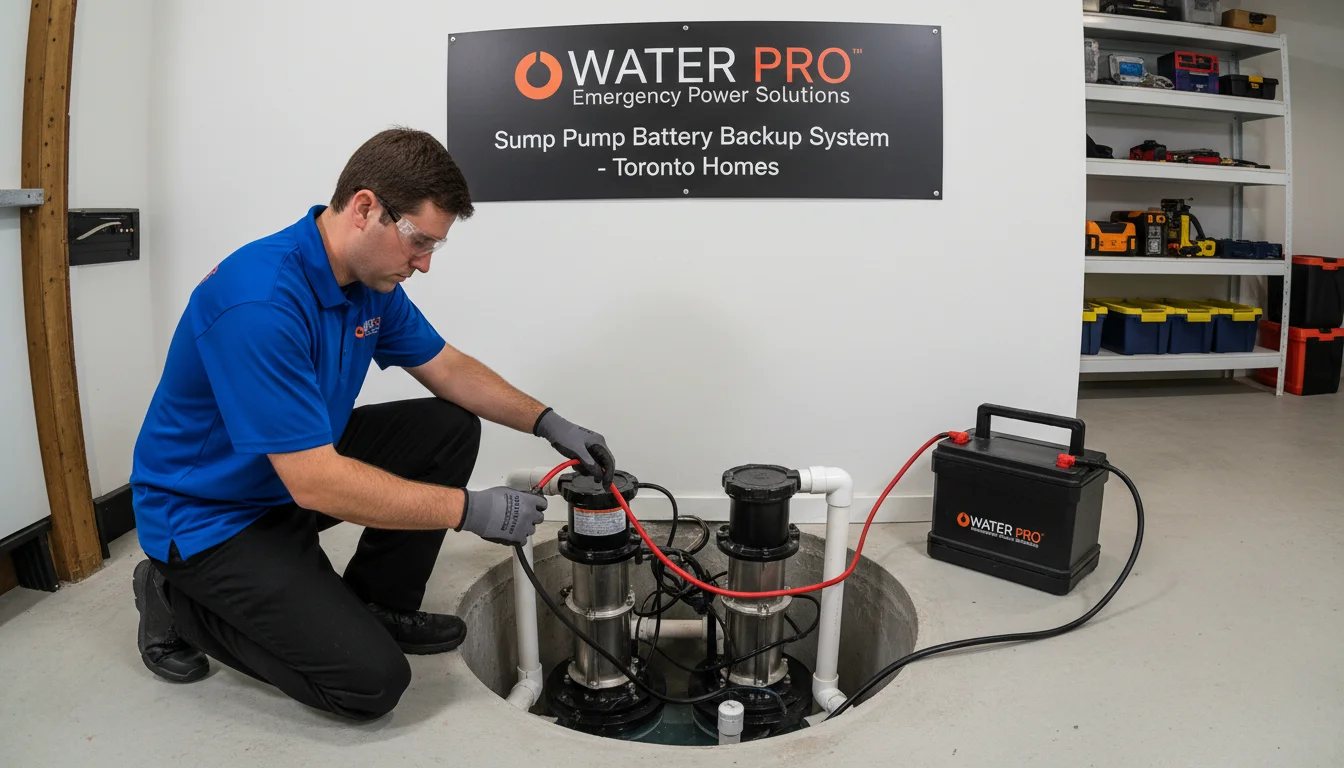
| Backup Type | Cost | Runtime | Pros | Cons |
|---|---|---|---|---|
| Battery Backup | $800-$1,500 | 5-7 hrs continuous 24-48 hrs intermittent |
No water waste Reliable Quiet City subsidy eligible |
Requires battery replacement (3-5 yrs) Limited runtime |
| Water-Powered | $600-$1,200 | Unlimited (if water available) | No electricity needed No batteries Works indefinitely |
Uses 1 gal water per 2 gal pumped Requires 40+ PSI $400-600/yr water cost Not eco-friendly |
| Whole-House Generator | $5,000-$15,000 | Days/weeks (with fuel) | Powers entire home Unlimited runtime Multi-purpose |
Very expensive Requires natural gas line Ongoing fuel costs Maintenance intensive |
| Portable Generator | $800-$2,500 | 8-12 hrs per tank | Multi-purpose Portable Lower upfront cost |
Requires manual setup Fuel storage Noise/exhaust Not automatic |
Why Battery Backup Wins for Most Toronto Homes
For typical power outages (2-8 hours), battery backup provides the best value:
- Automatic operation: Kicks in instantly when power fails—no manual intervention
- Cost-effective: 5-10x cheaper than generators, no ongoing water/fuel costs
- Eco-friendly: No water waste (important for Toronto's conservation efforts)
- Subsidy eligible: Toronto's Basement Flooding Protection Subsidy covers backup pumps
- Maintenance-friendly: Replace battery every 3-5 years vs. generator annual servicing
⚠️ Warning: Water-Powered Systems Waste Water
Water-powered backup pumps use 1 gallon of city water for every 2 gallons pumped. During a 6-hour outage, you might waste 1,000-2,000 gallons of treated drinking water ($400-$600 in annual water bills for occasional use). Toronto encourages water conservation—battery backup aligns with city environmental goals and qualifies for subsidies water-powered systems don't.
Battery Options: Deep Cycle vs. Maintenance-Free
Not all batteries are created equal. Choosing the right battery dramatically affects performance and lifespan:
Deep Cycle Marine Batteries (Recommended)
Best for: Toronto homeowners who want maximum runtime and longevity. Deep cycle batteries are designed for sustained discharge (exactly what sump pumps need) and handle Toronto's temperature fluctuations better than automotive batteries.
- Pros: Longest runtime, most charge cycles, best cold-weather performance
- Cons: Higher upfront cost, requires ventilation (hydrogen gas), monthly water checks
- Top brands: Interstate DCM0100, Mighty Max ML100-12, Universal UB121000
AGM Maintenance-Free Batteries
Absorbed Glass Mat (AGM) batteries are sealed, maintenance-free units ideal for homeowners who want "set it and forget it" operation.
- Pros: No maintenance, no ventilation required, spill-proof, can be mounted sideways
- Cons: 20-30% less runtime than equivalent deep cycle, shorter lifespan (3-4 years)
- Cost: $250-$400 for 75-100Ah capacity
- Best for: Finished basements where ventilation is limited or aesthetics matter
Lithium-Ion (Emerging Technology)
New to the market, lithium-ion sump pump batteries offer superior performance but at premium pricing:
- Pros: Longest runtime per weight, 2,000+ charge cycles, 7-10 year lifespan, cold-weather excellence
- Cons: 2-3x cost ($600-$1,000), limited availability, requires specialized charger
- Verdict: Great technology, but current pricing makes deep cycle marine batteries better value for most
💡 Pro Tip: Battery Sizing Rule
Minimum battery capacity = (Pump Amps × Desired Hours) ÷ 0.85. For a 7-amp pump running 5 hours: (7A × 5hr) ÷ 0.85 = 41Ah minimum. I recommend 2x this calculation (80-100Ah) for Toronto's unpredictable storms. Larger batteries last longer between replacements and provide buffer for unexpected extended outages.
How to Calculate Battery Backup Runtime
Understanding runtime calculations helps you choose the right battery and set realistic expectations:
📊 Battery Runtime Formula
Runtime (hours) = (Battery Ah × 12V × 0.85) ÷ (Pump Watts)
The 0.85 factor accounts for inverter efficiency losses and temperature effects.
Example Calculation:
- • Battery: 100Ah deep cycle marine battery
- • Pump: 1/3 HP (7 amps at 12V = 84 watts)
- • Continuous runtime: (100Ah × 12V × 0.85) ÷ 84W = 12.1 hours
- • Intermittent use (pump runs 25% of time): 48 hours
Note: Cold temperatures reduce battery capacity by 20-30%. In Toronto winters, factor in reduced performance.
Real-World Runtime Scenarios
Here's what different battery sizes provide for a typical 1/3 HP sump pump (7 amps):
| Battery Size | Continuous Pumping | Intermittent Use (25%) | Best For |
|---|---|---|---|
| 55Ah (Small) | 4-5 hours | 16-20 hours | Light water inflow areas |
| 75Ah (Standard) | 5-7 hours | 20-28 hours | Most Toronto homes |
| 100Ah (Large) | 8-12 hours | 32-48 hours | High water tables, peace of mind |
| Dual 100Ah (Premium) | 16-24 hours | 64-96 hours | Vacation homes, frequent outages |
Toronto-Specific Runtime Considerations
- Clay soil areas (Scarborough, North York): Higher water tables = more frequent pump cycles
- Ravine properties (Don Valley, Humber): Groundwater flow requires larger batteries
- Older homes (pre-1970): Weeping tile degradation increases pump workload
- Winter months: Battery capacity drops 20-30% in cold basements
Installation Requirements & Retrofit Options
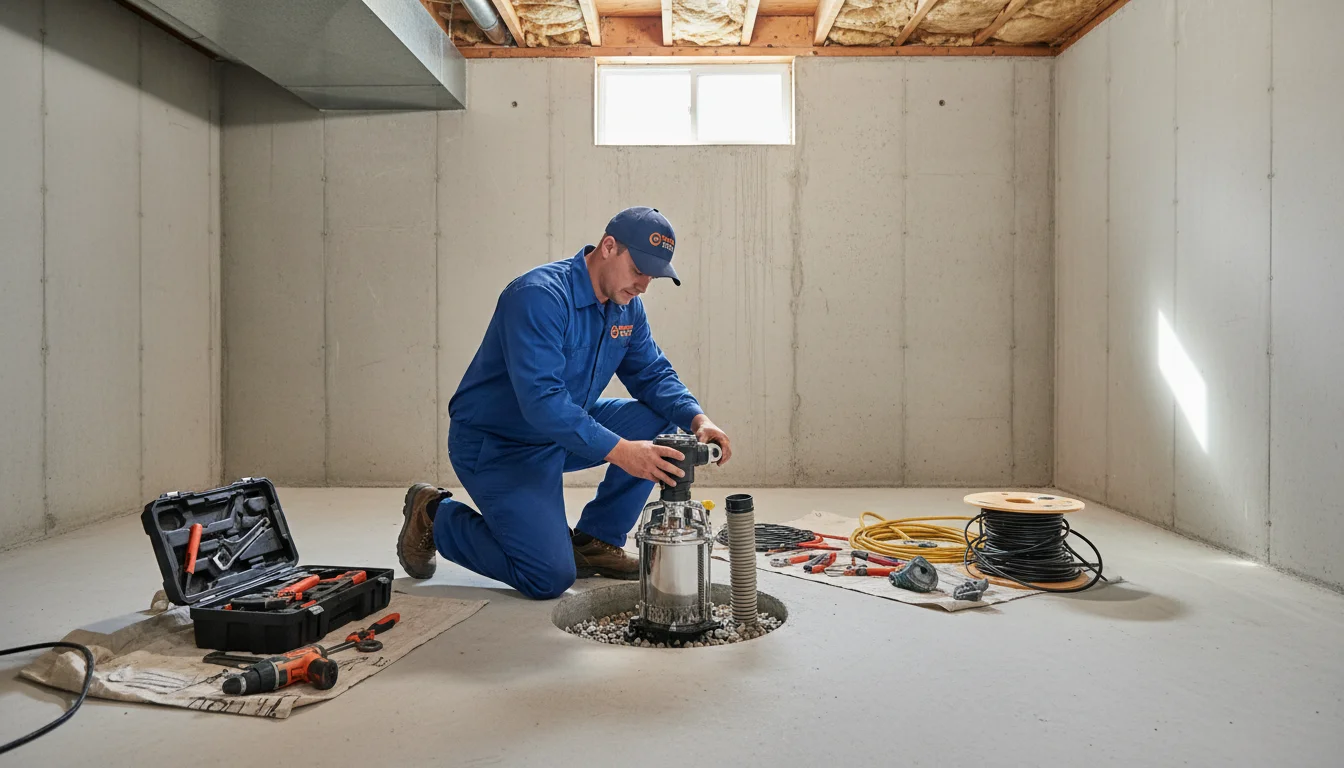
What's Needed for Retrofit Installation
Most battery backup systems retrofit to existing sump pumps. Here's what the installation involves:
1. Electrical Requirements
- Dedicated 15-amp circuit for battery charger (most homes have this)
- GFCI outlet within 6 feet of sump pit
- Proper grounding (critical for safety)
- Electrical work must meet Ontario Building Code Section 26 (drainage systems)
2. Plumbing Configuration
- Dual pump setup: Backup pump installs alongside primary pump in basin
- Check valves: Prevent backflow into sump pit
- Discharge pipe: May need Y-connector to join primary and backup discharge
- Basin size: Minimum 18" diameter for dual pump installation
3. Ventilation (For Wet Cell Batteries)
- Wet cell batteries emit hydrogen gas during charging
- Battery box must vent to exterior or well-ventilated area
- Not required for sealed AGM batteries
DIY vs. Professional Installation
While mechanically inclined homeowners can install battery backup systems, I strongly recommend professional installation for several reasons:
⚠️ Why Professional Installation Matters
- • Insurance requirements: Some policies require licensed installation for flood claims
- • Toronto subsidy compliance: Subsidy requires licensed contractor with receipts
- • Building code compliance: Electrical and plumbing must meet Ontario codes
- • Warranty protection: Manufacturer warranties often void with DIY installation
- • Safety: Improper installation risks electrical hazards, flooding, property damage
Professional installation costs $200-$400 but includes proper electrical connections, code-compliant plumbing, testing, and documentation for insurance/subsidies. Call Water Pro at (647) 554-4356 for licensed installation across the GTA.
Toronto Basement Flooding Subsidy Program
Toronto homeowners can recover significant costs through the city's Basement Flooding Protection Subsidy Program:
Subsidy Details (2025)
- Maximum subsidy: Up to $3,400 per property
- Eligible improvements: Battery backup sump pumps, backwater valves, sewer severance & capping
- Coverage: 80% of eligible costs up to subsidy maximum
- Application: Must apply BEFORE starting work (applications take 4-8 weeks)
- Requirements: Licensed contractor, permits where required, receipts, inspection
How to Apply
- Check eligibility: Visit City of Toronto Subsidy Page
- Get quotes: Obtain written quotes from licensed contractors (Water Pro provides subsidy-compliant quotes)
- Submit application: Complete online application with property details and contractor quotes
- Wait for approval: City reviews application (4-8 weeks typical)
- Complete work: Hire licensed contractor after approval
- Submit receipts: Final inspection and receipt submission
- Receive payment: Subsidy paid within 4-6 weeks of final approval
💡 Pro Tip: Maximize Your Subsidy
Consider combining multiple flood prevention measures in one application: battery backup sump pump + backwater valve installation can qualify for the full $3,400 subsidy. The backwater valve alone covers $1,250-$1,750, plus $800-$1,500 for battery backup = $2,050-$3,250 in eligible costs. Smart bundling maximizes your subsidy benefit and provides comprehensive protection.
Complete Cost Breakdown
| Component | Cost Range | Notes |
|---|---|---|
| Deep Cycle Battery (75-100Ah) | $200-$350 | Replace every 3-5 years |
| Backup Pump System | $400-$800 | Includes pump, switch, charger |
| Installation (Professional) | $200-$400 | Licensed plumber + electrician |
| Plumbing Materials | $50-$150 | Pipes, valves, connectors |
| Electrical Work | $0-$200 | If new circuit needed |
| Total System Cost | $850-$1,900 | Complete turnkey installation |
| After Toronto Subsidy (80%) | $170-$380 | Net cost to homeowner |
Annual Operating Costs
- Electricity (battery charging): $12-$18/year
- Battery replacement reserve: $50-$70/year (amortized over 3-5 years)
- Annual testing/maintenance: $0-$150 (if hiring professional vs. DIY)
- Total annual cost: $62-$238/year
Compare this to one basement flooding incident: $15,000-$50,000 in damages, insurance deductibles, increased premiums, and displacement costs. Battery backup is insurance that pays for itself the first time it prevents flooding.
Maintenance Requirements
Battery backup systems require minimal maintenance, but regular checks ensure reliability when you need it:
Monthly Tasks (5 Minutes)
- Check battery charge indicator light (should show green/full charge)
- Test alarm function (most systems have test button)
- Visual inspection for corrosion on battery terminals
- Verify no unusual odors (rotten egg smell = battery issue)
Quarterly Tasks (15 Minutes)
- Simulate power outage: Unplug charger and pour water in basin to activate backup pump
- Verify pump starts automatically and pumps water out
- Check discharge pipe for proper flow
- Reconnect charger and verify charging resumes
Annual Tasks (30-60 Minutes)
- Clean pump intake screens
- Test all float switches (primary and backup)
- Inspect battery terminals and clean if corroded
- Check battery water level (wet cell batteries only)—add distilled water if low
- Inspect all plumbing connections for leaks
- Test alarm under actual power-loss conditions
- Verify check valves operate correctly
Toronto-Specific Seasonal Maintenance
Before Winter (November)
- Full system test before heating season
- Check battery in cold basement conditions
- Insulate discharge pipes against freezing
- Verify backup power during first cold snap
Before Spring Thaw (March)
- Test system before snow melt season
- Replace battery if showing reduced capacity
- Clean sump pit of winter debris
- Verify discharge lines aren't frozen
💡 Pro Tip: Set Phone Reminders
Set recurring calendar reminders on your phone for monthly, quarterly, and seasonal checks. Most basement flooding from backup system failures happens because homeowners forgot to maintain them. Five minutes monthly prevents thousands in damage. Water Pro offers annual maintenance plans ($199/year) that include professional testing and battery health checks—call (647) 554-4356 for details.
Frequently Asked Questions
A typical sump pump battery backup lasts 5-7 hours of continuous pumping or 24-48 hours with intermittent use. Runtime depends on battery capacity (75-100Ah recommended), pump amperage, and water inflow rate. Deep cycle marine batteries provide the best performance for Toronto homes.
Most Toronto homes need a 75-100Ah deep cycle battery for adequate backup. Larger homes or areas with high water tables may require dual batteries (150-200Ah combined). Calculate runtime using: Battery Amp-Hours ÷ Pump Amps × 0.85 (efficiency factor) = Hours of operation. I recommend 2x your minimum calculated needs for safety margin.
Battery backup sump pump installation costs $800-$1,500 in Toronto. This includes battery ($200-$400), backup pump system ($400-$800), and professional installation ($200-$300). Toronto's Basement Flooding Protection Subsidy covers up to 80% of costs (maximum $3,400), reducing your net cost to $170-$380.
Battery backup provides better value for most Toronto homes. It offers consistent performance, no water waste (important for city conservation), lower operating costs, and qualifies for city subsidies. Water-powered systems work during extended outages but waste 1 gallon of city water per 2 gallons pumped, adding $400-$600 annually in water costs. They also require minimum 40 PSI water pressure, which not all Toronto homes have.
Replace sump pump batteries every 3-5 years. Deep cycle marine batteries last longer (4-5 years) than standard batteries (2-3 years). Toronto's freeze-thaw cycles and basement temperature fluctuations stress batteries more than stable climates. Test battery capacity quarterly—replace when runtime drops below 50% of original capacity, even if the battery is less than 5 years old.
Yes. Toronto's Basement Flooding Protection Subsidy Program offers up to $3,400 for flood prevention measures, including battery backup sump pumps. The subsidy covers 80% of eligible costs. Requirements: apply before starting work, use licensed contractors, obtain permits where required, and submit receipts. Visit toronto.ca for application details or call Water Pro at (647) 554-4356 for subsidy-compliant installation.
Yes, most battery backup systems retrofit to existing sump pumps. Retrofit installation costs $600-$1,000 vs. $1,200-$1,800 for complete new systems. Your existing pump remains as the primary pump; the battery backup acts as secondary protection during power outages. Requirements: adequate basin size (18" minimum diameter), compatible discharge pipe configuration, and proper electrical setup. Professional assessment recommended to verify compatibility.
Monthly: Test battery charge indicator and alarm (5 minutes). Quarterly: Pour water in basin to verify backup pump activates (15 minutes). Annually: Clean pump intake, check battery terminals for corrosion, test float switches, inspect discharge pipes, verify check valves work (30-60 minutes). Toronto-specific: Test before winter (November) and spring thaw (March). Replace battery every 3-5 years. Water Pro offers annual maintenance plans ($199/year) including professional testing.
The Bottom Line
Sump pump battery backup systems cost $800-$1,500 installed but provide invaluable protection during Toronto's unpredictable power outages. With the city's Basement Flooding Subsidy covering up to 80% of costs, your net investment drops to $170-$380—a fraction of typical flood damage costs ($15,000-$50,000).
For most GTA homeowners, a 75-100Ah deep cycle marine battery paired with a quality backup pump provides 5-7 hours of continuous operation or 24-48 hours of intermittent protection. This covers typical storm-related outages and provides peace of mind during Toronto's harsh winters and summer thunderstorms.
Don't wait for the next power outage to discover your vulnerability. Battery backup systems install in 2-4 hours and protect your basement for years to come.
Protect Your Basement with Battery Backup
Licensed installation with Toronto subsidy assistance. Same-day service available across the GTA.
📞 Call (647) 554-4356Free quote • City subsidy assistance • 90-day guarantee • 5,234+ families helped
Related Articles

About Mike Thompson
Master Plumber • License #MP-2847 • 28 Years Experience
Mike has installed over 2,000 sump pump systems across the GTA since 1996. He specializes in battery backup installations and helps Toronto homeowners navigate city subsidy programs. Member of the Canadian Institute of Plumbing & Heating (CIPH) and Ontario Plumbing Inspectors Association (OPIA).
🏆 2023 Best Plumber Award - Toronto Home Services • Featured in Toronto Star, BlogTO