
Quick Answer
Most hot water tank problems fall into 5 categories: no hot water (pilot/thermostat/element), leaking (valves or tank corrosion), strange noises (sediment buildup), rusty water (depleted anode rod), or not enough hot water (undersized tank or thermostat issues). Repairs typically cost $150-$500; replacement costs $1,500-$2,500 installed.
Key Takeaways
- ✓ No hot water: Check pilot light (gas) or reset high-limit switch (electric) first
- ✓ Bottom leaks = tank failure; top leaks often repairable
- ✓ Rumbling/popping = sediment; annual flushing prevents this
- ✓ Rusty water = replace anode rod before tank corrodes
- ✓ Replace if: 10+ years old, leaking from bottom, or repair > 50% of replacement
Table of Contents
Problem #1: No Hot Water
You turn on the shower and... nothing but cold water. No hot water is the most common water heater complaint, and often the easiest to diagnose. The cause depends on whether you have a gas or electric tank.
🔥 Gas Tank: No Hot Water
Most likely causes:
- 1. Pilot light is out: Look through the access panel—you should see a small blue flame. If not, relight following label instructions.
- 2. Thermocouple failure: Pilot won't stay lit after releasing the knob. Thermocouple needs replacement ($150-$250).
- 3. Gas valve failure: No gas reaching burner. Requires professional diagnosis and replacement ($300-$500).
- 4. Blocked vent: Safety shuts off burner. Check for bird nests or debris in roof vent.
⚡ Electric Tank: No Hot Water
Most likely causes:
- 1. Tripped breaker: Check electrical panel. Reset if tripped. If it trips again, call an electrician.
- 2. High-limit reset: Red button on upper thermostat. Press to reset. Repeat trips indicate element or thermostat failure.
- 3. Thermostat failure: Not sending signal to elements. Replacement costs $150-$250.
- 4. Heating element burnout: Elements corrode over time, especially in hard water. Replacement costs $175-$300.
DIY Troubleshooting Steps
- 1. Check pilot light (gas) or breaker (electric)—free fix
- 2. Reset high-limit switch (electric)—free fix
- 3. Check thermostat setting—should be 120°F/49°C
- 4. Wait 30-60 minutes—if tank was empty, it needs time to heat
- 5. Still no hot water? Call for professional diagnosis
Problem #2: Tank is Leaking
Water around your tank is alarming, but not all leaks mean the tank is failing. Location tells you everything: top leaks are usually repairable; bottom leaks often mean replacement.
Where is the Water Coming From?
| Leak Location | Likely Cause | Fix | Cost |
|---|---|---|---|
| Top (inlet/outlet) | Loose or corroded fittings | Tighten or replace fittings | $100-$200 |
| Side (T&P valve) | Pressure relief discharge | Test valve; may need replacement | $150-$250 |
| Bottom (drain valve) | Drain valve drip | Replace drain valve | $75-$150 |
| Bottom (tank itself) | Internal tank corrosion | Tank replacement | $1,500-$2,500 |
| Condensation | Cold inlet vs. hot tank | Normal; wipe dry | $0 |
Understanding the T&P Valve
The Temperature & Pressure (T&P) relief valve is a critical safety device. It releases water if pressure exceeds 150 PSI or temperature exceeds 210°F. If water is dripping from the T&P valve discharge pipe:
- Occasional drips: Thermal expansion—normal if you have a closed system. Install expansion tank.
- Continuous stream: Valve may be faulty or water pressure too high. Test with pressure gauge.
- Never opens: Dangerous. Valve may be stuck. Replace immediately.
Emergency: Tank Leaking from Bottom
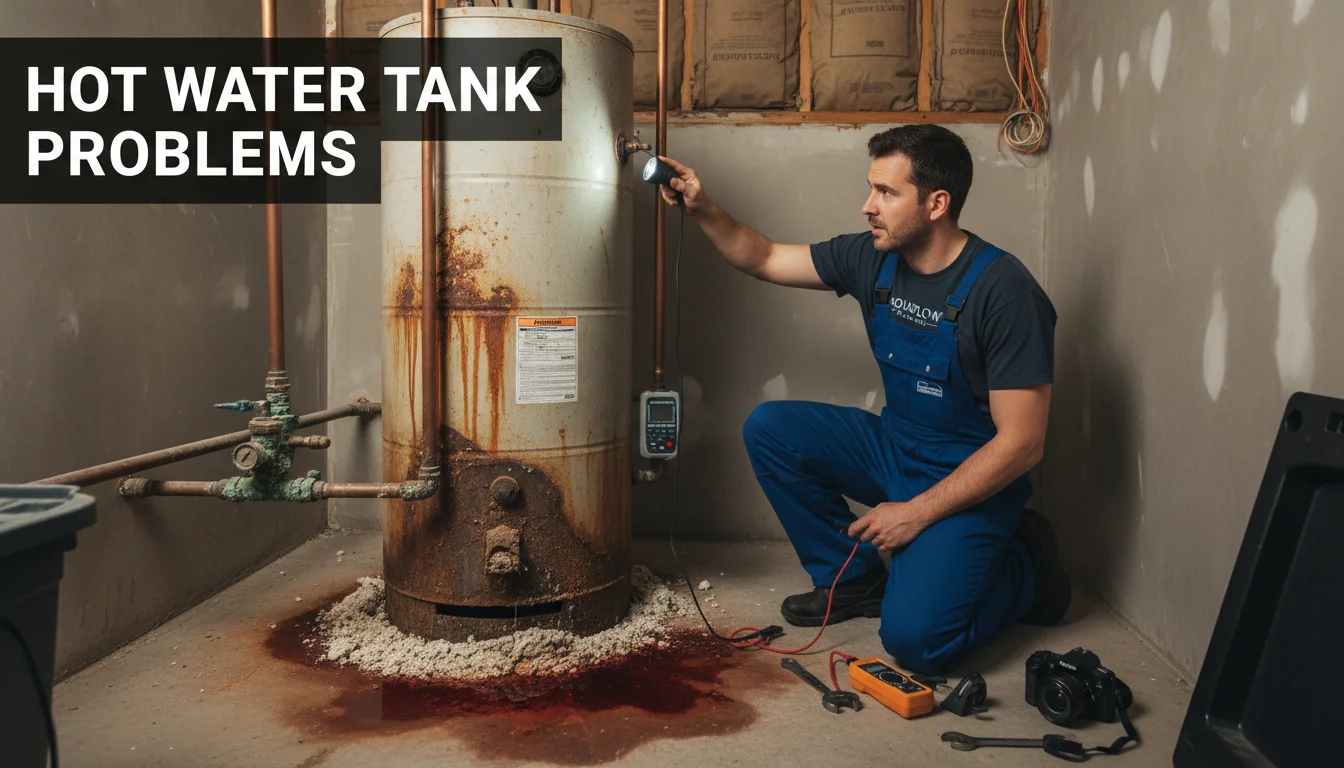
If water is pooling under the tank from a seam or the tank bottom: shut off gas/power immediately, close the cold water inlet valve, and call for emergency service. A failing tank can rupture, releasing 40-60 gallons of hot water and causing significant water damage.
Problem #3: Strange Noises
Your water heater shouldn't sound like a coffee maker, kettle, or rock tumbler. Strange noises usually indicate sediment buildup—especially common in Toronto with our moderately hard water (124 mg/L).
Noise Diagnosis Guide
| Sound | Cause | Solution |
|---|---|---|
| Rumbling/Boiling | Sediment on tank bottom; water boils beneath it | Flush tank; professional power flush if severe |
| Popping/Cracking | Mineral scale on elements or tank bottom | Descale elements; consider water softener |
| Sizzling | Condensation dripping on burner (gas) | Normal during first recovery; investigate if constant |
| Humming | Vibrating heating element (electric) | Tighten element; replace if damaged |
| Ticking/Tapping | Thermal expansion of pipes/fittings | Normal; add pipe insulation to reduce |
| High-Pitched Whine | Partially closed valve restricting flow | Fully open inlet valve; check PRV |
Why Sediment Matters
Sediment—calcium, magnesium, and other minerals—settles on the tank bottom over time. This layer:
- Insulates the tank bottom, reducing heating efficiency by 10-20%
- Creates hot spots that accelerate tank corrosion
- Causes rumbling as water boils under the sediment layer
- Can clog the drain valve, making flushing difficult
Prevention: Annual Tank Flushing
Connect a hose to the drain valve, turn off gas/power, open the valve, and drain 3-5 gallons until water runs clear. Do this yearly. If water doesn't flow (clogged valve), call for professional service—they can use a pump to force sediment out.
Problem #4: Rusty or Smelly Water
Rusty/Brown Hot Water
If only your hot water is rusty (cold runs clear), the problem is in your water heater—not your pipes. The culprit is usually a depleted anode rod.
The Anode Rod: Your Tank's Sacrificial Protector
Every tank has a magnesium or aluminum rod that attracts corrosive elements in the water, sacrificing itself to protect the steel tank. When the anode is depleted (typically after 3-5 years), the tank itself starts corroding.
- Signs of depleted anode: Rusty hot water, sulfur smell, exposed core wire on rod
- Replacement cost: $200-$350 (much cheaper than tank replacement)
- Recommendation: Inspect every 3 years; replace as needed
Rotten Egg Smell (Sulfur)
That sulfur/rotten egg smell in hot water comes from bacteria reacting with the anode rod. This is common in Toronto homes that:
- Use well water
- Have water heaters set below 120°F
- Leave the home vacant for extended periods
Fixes for Sulfur Smell
- 1. Flush the tank thoroughly
- 2. Raise temperature to 140°F for 2 hours to kill bacteria (caution: scald risk)
- 3. Replace magnesium anode with aluminum/zinc version (less reactive)
- 4. Add hydrogen peroxide sanitizer treatment (professional service)
Problem #5: Not Enough Hot Water
Running out of hot water mid-shower is frustrating. Here's why it happens and how to fix it:
| Cause | Symptoms | Solution |
|---|---|---|
| Undersized tank | Never had enough hot water | Upgrade to larger tank or tankless |
| Thermostat set too low | Water barely warm | Increase to 120°F/49°C |
| Sediment buildup | Less hot water over time | Flush tank; power flush if severe |
| Dip tube failure | Sudden drop in hot water supply | Replace dip tube ($150-$250) |
| Lower element burnout (electric) | Only 1/3 of tank heats | Replace lower element ($175-$300) |
| Crossover from plumbing | Cold water enters hot supply | Check mixing valves, single-handle faucets |
The Dip Tube Problem
The dip tube sends cold inlet water to the tank bottom for heating. If it breaks or deteriorates, cold water mixes with hot water at the top, drastically reducing your hot water supply. Signs:
- Small white plastic pieces in faucet aerators
- Sudden decrease in hot water (days to weeks)
- Tank is 10-20 years old
Repair Costs in Toronto
| Repair | Cost Range | Includes |
|---|---|---|
| Thermostat replacement | $150-$250 | Parts + labour |
| Thermocouple (gas) | $150-$250 | Parts + labour + testing |
| Heating element (electric) | $175-$300 | Parts + labour + testing |
| Anode rod replacement | $200-$350 | Parts + labour + tank flush |
| T&P valve replacement | $150-$250 | Parts + labour |
| Gas valve replacement | $300-$500 | Parts + labour + safety test |
| Dip tube replacement | $150-$250 | Parts + labour |
| Tank flush (sediment) | $100-$200 | Drain, flush, refill |
| Power flush (severe sediment) | $200-$350 | Pump-assisted flush |
When to Replace vs. Repair
✓ Repair If:
- • Tank is less than 8 years old
- • Problem is a component (thermostat, element, valve)
- • No visible corrosion or rust
- • No leaks from tank body
- • Repair cost is less than 50% of replacement
✗ Replace If:
- • Tank is 10+ years old
- • Leaking from tank bottom or seams
- • Multiple repairs needed
- • Heavy corrosion visible
- • Repair cost exceeds 50% of new tank
- • Tank is rented (often cheaper to buy new)
Tank Replacement Costs in Toronto
| Tank Type | Total Installed | Includes |
|---|---|---|
| 40-gallon gas | $1,500-$2,200 | Tank + installation + disposal |
| 50-gallon gas | $1,800-$2,500 | Tank + installation + disposal |
| 40-gallon electric | $1,200-$1,800 | Tank + installation + disposal |
| 50-gallon electric | $1,400-$2,000 | Tank + installation + disposal |
Note: These are for tank swap (same fuel type, same location). Upgrades, relocations, or fuel conversions cost more.
Hot Water Tank Acting Up?
Our licensed technicians can diagnose your water heater problem and provide honest advice on repair vs. replacement. Same-day emergency service available.
Frequently Asked Questions
Why do I have no hot water from my tank?
No hot water usually means: pilot light is out (gas), thermostat failure, heating element burnout (electric), or gas valve malfunction. Check pilot light first on gas tanks. Reset the high-limit switch on electric tanks. If neither works, call for service.
Why is my hot water tank leaking?
Tank leaks come from: pressure relief valve discharge (normal or faulty valve), drain valve drips, inlet/outlet connections, or tank corrosion. Bottom leaks usually indicate tank failure requiring replacement. Top leaks are often repairable.
What causes a hot water tank to make rumbling or popping noises?
Rumbling or popping noises indicate sediment buildup on the tank bottom. Water trapped under sediment boils and creates noise. Flushing the tank annually prevents this. Heavy buildup may require professional power flushing or tank replacement.
How much does hot water tank repair cost in Toronto?
Hot water tank repairs in Toronto cost $150-$500 depending on the issue: thermostat replacement $150-$250, heating element $175-$300, anode rod $200-$350, gas valve $300-$500. Tank replacement costs $1,500-$2,500 installed.
When should I replace vs repair my hot water tank?
Replace if: tank is 10+ years old, leaking from the bottom, heavily corroded, or repair costs exceed 50% of replacement cost. Repair if: tank is under 8 years old, problem is a component failure (thermostat, element, valve), and no visible corrosion.
Why is my hot water rusty or brown?
Rusty hot water indicates: depleted anode rod (most common), corroding tank interior, or rusty pipes. If only hot water is rusty, the problem is your tank. If both hot and cold are rusty, it's your pipes or municipal water supply.
Mike Thompson
Master Plumber, 25+ Years Experience
Mike has repaired and replaced thousands of water heaters across the GTA. He's seen every failure mode and knows when a repair makes sense vs. when it's time to invest in new equipment.