
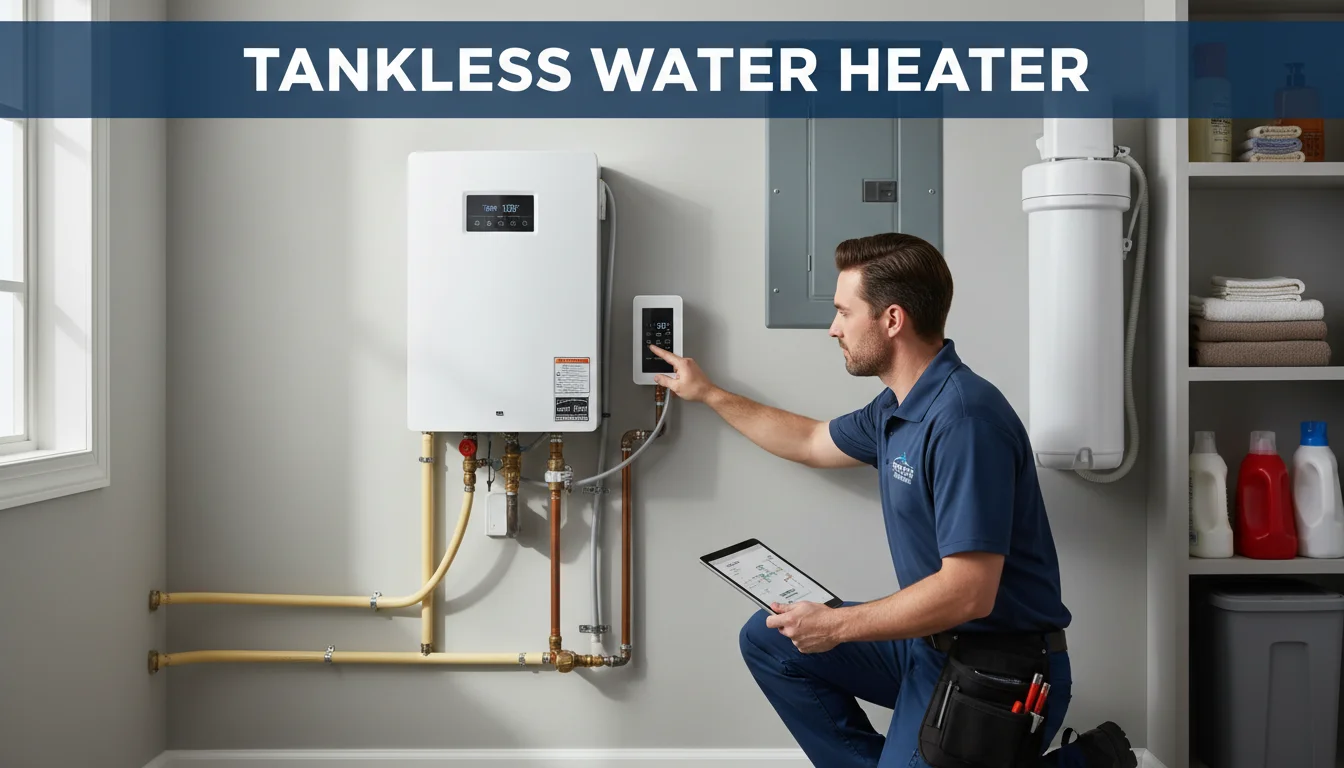
Quick Answer
Tankless water heater installation in Toronto costs $3,000-$6,000 total, including the unit ($1,500-$3,000) and professional installation ($1,500-$3,000). Gas tankless provides endless hot water, 20-30% energy savings, and lasts 20+ years. Proper sizing is critical for Toronto's cold winter inlet water temperatures.
Key Takeaways
- ✓ Gas tankless heaters cost $3,000-$6,000 installed; electric units $1,500-$3,500
- ✓ Save 20-30% on water heating costs vs. traditional tank
- ✓ 20-25 year lifespan—nearly double a tank heater
- ✓ Gas is better for Toronto winters; electric for single-point use
- ✓ Proper sizing essential for cold inlet water (4°C in January)
Table of Contents
How Tankless Water Heaters Work
Traditional tank water heaters store 40-60 gallons of hot water 24/7, constantly burning energy to maintain temperature—even when you're asleep or at work. Tankless water heaters, also called on-demand or instantaneous heaters, take a completely different approach.
When you turn on a hot water tap, cold water flows into the tankless unit. Sensors detect the flow and instantly ignite a gas burner or activate electric heating elements. The heat exchanger rapidly heats the water as it passes through—typically raising temperature by 35-50°C in seconds. When you close the tap, heating stops immediately.
The Flow Rate Factor
Tankless heaters are rated by flow rate (gallons per minute or GPM) rather than tank capacity. A unit's GPM rating tells you how much hot water it can produce simultaneously. This is where Toronto's cold climate matters: the colder the incoming water, the harder the unit works to reach your desired temperature.
Toronto Inlet Water Temperatures by Season
| Season | Inlet Temp | Required Rise to 49°C |
|---|---|---|
| Winter (Jan-Feb) | 4-6°C (39-43°F) | 43-45°C (77-81°F) |
| Spring (Apr-May) | 10-14°C (50-57°F) | 35-39°C (63-70°F) |
| Summer (Jul-Aug) | 18-22°C (64-72°F) | 27-31°C (49-56°F) |
| Fall (Oct-Nov) | 12-16°C (54-61°F) | 33-37°C (59-67°F) |
Toronto Winter Reality Check
A tankless unit rated for 5.5 GPM at 25°C rise (typical for California) may only deliver 2.5-3 GPM in a Toronto January. Always check the manufacturer's specification at 45°C temperature rise, not summer conditions.
Toronto Installation Costs Breakdown
Tankless water heater costs in Toronto depend heavily on fuel type, unit capacity, and whether you're upgrading from an existing tankless or converting from a tank heater.
Gas Tankless Water Heaters
| Component | Cost Range | Notes |
|---|---|---|
| Unit (180-199K BTU) | $1,500-$2,500 | Rinnai, Navien, Noritz |
| Installation Labour | $800-$1,500 | 4-8 hours typical |
| Gas Line Upgrade | $300-$800 | Often required for 3/4" line |
| Venting (PVC) | $200-$600 | Concentric or dual-pipe |
| Permits & Inspection | $150-$300 | ESA & TSSA required |
| Total (Gas) | $3,000-$6,000 | Typical range |
Electric Tankless Water Heaters
| Component | Cost Range | Notes |
|---|---|---|
| Unit (Whole-Home) | $800-$1,500 | Stiebel Eltron, Rheem |
| Unit (Point-of-Use) | $150-$400 | Single fixture |
| Installation Labour | $400-$800 | Simpler than gas |
| Electrical Panel Upgrade | $500-$2,000 | 200A panel often needed |
| Permits & ESA Inspection | $100-$200 | Required in Toronto |
| Total (Electric) | $1,500-$4,500 | Higher if panel upgrade needed |
Pro Tip: Hidden Upgrade Costs
Many Toronto homes built before 1990 have 1/2" gas lines—inadequate for a whole-home tankless. Budget an extra $500-$1,200 for gas line upgrades. Similarly, most older homes have 100-amp electrical panels, requiring a $1,500-$2,500 upgrade for electric whole-home tankless.
Gas vs. Electric: Toronto Climate Considerations
This choice is straightforward for most Toronto homes: gas wins for whole-home use, electric for single-point applications. Here's the detailed comparison:
| Factor | Gas | Electric |
|---|---|---|
| Flow Rate (Winter) | 4-6 GPM | 2-3.5 GPM |
| Simultaneous Uses | 2-3 fixtures | 1-2 fixtures |
| Operating Cost (Toronto) | $25-$40/month | $45-$75/month |
| Installation Cost | $3,000-$6,000 | $1,500-$4,500 |
| Venting Required | Yes (PVC) | No |
| Power Outages | No hot water | No hot water |
| Best Use Case | Whole home | Single bathroom, cottage |
Why Gas Dominates in Toronto
Toronto's cold winter inlet temperatures (4-6°C) demand high heating capacity. A gas tankless rated at 199,000 BTU can raise water temperature 45°C at 4+ GPM—enough for a shower and dishwasher running simultaneously. Electric units, limited by panel capacity, typically max out at 36kW (about 123,000 BTU equivalent), delivering 2-2.5 GPM at the same temperature rise.
Plus, Enbridge natural gas costs roughly $0.30/m³, while Toronto Hydro electricity runs $0.12-$0.18/kWh. Gas provides about 3x the BTU per dollar, making monthly operating costs significantly lower.
When Electric Makes Sense
- Point-of-use applications: A $200-$400 electric unit under a sink provides instant hot water, eliminating the wait for water from a distant heater
- Cottages: No gas line? Electric is your only option
- Additions: Adding a bathroom suite far from the main heater
- Net-zero homes: Paired with solar panels and heat pump HVAC
Sizing Guide for Toronto Homes
Undersized tankless heaters are the #1 cause of customer dissatisfaction. Here's how to properly size a unit for Toronto's climate:
Step 1: Calculate Peak Demand
Typical Flow Rates
| Fixture | Flow Rate (GPM) |
|---|---|
| Shower (standard) | 1.5-2.0 |
| Shower (rain head) | 2.5-3.0 |
| Bathroom faucet | 0.5-1.0 |
| Kitchen faucet | 1.0-1.5 |
| Dishwasher | 1.0-1.5 |
| Washing machine | 1.5-2.0 |
Add up your maximum simultaneous usage. For a typical Toronto family, this might be:
• Shower #1: 2.0 GPM
• Shower #2: 2.0 GPM
• Kitchen faucet: 1.0 GPM
Total: 5.0 GPM peak demand
Step 2: Check Winter Capacity
Look up the unit's GPM rating at 45°C (81°F) temperature rise—not the summer spec. For the 5.0 GPM example above, you need a gas unit rated 199,000+ BTU. Common models:
| Model | BTU | GPM @ 45°C Rise | Price |
|---|---|---|---|
| Rinnai RU199iN | 199,000 | 5.3 GPM | $2,200 |
| Navien NPE-240A | 199,900 | 5.4 GPM | $2,100 |
| Noritz NRCP1112 | 199,900 | 5.6 GPM | $2,400 |
Pro Tip: Size Up for Toronto
Always add 15-20% buffer to your calculated GPM for Toronto homes. That "5.0 GPM" requirement should be served by a unit rated 6+ GPM at 45°C rise. January morning showers shouldn't be a compromise.
Pros and Cons: Is It Worth It?
✓ Pros
- Endless hot water: No tank to deplete—shower as long as you want
- Energy savings: 20-30% lower water heating costs (no standby heat loss)
- Longer lifespan: 20-25 years vs. 10-12 for tank
- Space savings: Wall-mounted, frees up floor space
- No flood risk: No 40-60 gallon tank to rupture
- Clean water: No sediment buildup like tank heaters
✗ Cons
- Higher upfront cost: $3,000-$6,000 vs. $1,500-$2,500 for tank
- "Cold water sandwich": Brief cold bursts between uses
- Limited flow in winter: May not handle 3+ simultaneous uses
- Annual maintenance: Descaling required ($150-$250/year)
- Complex repairs: Electronic components can fail
- No hot water in power outage: Unlike older standing pilot gas tanks
ROI Calculation for Toronto
Let's compare a $5,000 gas tankless vs. a $2,000 tank heater:
| Factor | Tank | Tankless |
|---|---|---|
| Initial cost | $2,000 | $5,000 |
| Annual gas cost | $480 | $340 |
| Annual savings | — | $140 |
| Lifespan | 12 years | 22 years |
| Total 22-year cost | $14,560 (2 tanks) | $12,480 |
Tankless breaks even around year 7-8 and saves $2,000+ over 22 years. Higher-usage households see faster payback.
Installation Requirements
Tankless installation is more complex than a tank swap. Here's what's typically involved for a Toronto gas tankless retrofit:
Gas Line Requirements
- 3/4" gas line minimum for most whole-home units (many older Toronto homes have 1/2")
- Gas meter capacity: May need Enbridge to upgrade your meter
- TSSA inspection: Required for all gas work in Ontario ($150-$200)
Venting Requirements
- Condensing units: Use PVC venting—can vent horizontally through wall
- Non-condensing: Require stainless steel venting—more expensive
- Concentric venting: Single penetration for intake and exhaust (cleanest install)
- Clearances: 12" minimum from windows, 4' from dryer vents
Location Considerations
Wall-mounted units need:
- Proximity to exterior wall for venting
- Floor drain or condensate pump nearby (condensing units produce acidic condensate)
- Electrical outlet (all units need 120V power, even gas)
- Cold climate protection if installed in unheated space
Permit Requirements in Toronto
Both gas and electric tankless installations require permits in Toronto. Gas work needs TSSA inspection; electrical needs ESA inspection. Budget $150-$300 for permits. Unpermitted work can void insurance and cause issues when selling.
Maintenance & Descaling
Toronto's moderately hard water (124 mg/L average) means annual descaling is essential for tankless heater longevity. Skip it, and mineral buildup reduces efficiency and eventually causes error codes.
Annual Descaling Procedure
- 1. Shut off: Close gas valve, cold water inlet, and hot water outlet valves
- 2. Connect hoses: Attach to service ports (most units have built-in isolation valves)
- 3. Pump solution: Circulate 4L of white vinegar or commercial descaler for 45-60 minutes
- 4. Flush: Open cold water to flush the system, drain vinegar
- 5. Clean filter: Remove and rinse the inlet filter screen
- 6. Restore: Open valves, restore power, test operation
Descaling Costs
- DIY: $30-$50 for pump kit + vinegar (reusable pump)
- Professional: $150-$250 per visit
- Water softener: Reduces descaling frequency to every 2-3 years
Pro Tip: Error Code 11/12
If your tankless throws error code 11 (ignition failure) or 12 (flame loss), mineral buildup in the heat exchanger is often the culprit. Descaling resolves 70% of these cases. Call for service if it persists after cleaning.
Considering Tankless for Your Toronto Home?
Our licensed technicians can assess your home, recommend the right size unit, and provide a complete installation quote. We handle gas line upgrades, venting, permits, and TSSA inspection—turnkey service.
Frequently Asked Questions
How much does a tankless water heater cost in Toronto?
Tankless water heater installation in Toronto costs $3,000-$6,000 total, including $1,500-$3,000 for the unit and $1,500-$3,000 for professional installation. Gas units cost more than electric but offer higher flow rates.
Is a tankless water heater worth it in Toronto?
Yes, for most Toronto homes. Tankless heaters save 20-30% on energy costs, last 20+ years (vs 10-12 for tank), provide endless hot water, and save floor space. The higher upfront cost pays back in 5-8 years through energy savings.
Can a tankless water heater keep up with Toronto winters?
Yes, but sizing is critical. Toronto's incoming water temperature drops to 4°C (39°F) in winter. A properly sized gas tankless unit (199,000+ BTU) can deliver 4+ GPM even in winter. Electric units may struggle with multiple simultaneous uses.
Gas vs electric tankless: which is better for Toronto?
Gas tankless is better for whole-home use in Toronto—higher flow rates (4-8 GPM), handles cold winter inlet temperatures, and natural gas is cheaper than electricity. Electric tankless works for single-point applications like a bathroom or cottage.
What size tankless water heater do I need?
For a 3-bedroom Toronto home, you need 199,000+ BTU gas tankless to handle 2-3 simultaneous fixtures. Calculate your peak demand: shower (2 GPM) + dishwasher (1.5 GPM) + faucet (0.5 GPM) = 4 GPM. Add 50% winter buffer.
How long do tankless water heaters last?
Quality tankless water heaters last 20-25 years with proper maintenance, nearly double the 10-12 year lifespan of traditional tank heaters. Annual descaling is essential in Toronto due to our moderately hard water (124 mg/L).
Mike Thompson
Master Plumber, 25+ Years Experience
Mike has installed over 500 tankless water heaters across the GTA since 2005. He specializes in retrofitting older Toronto homes and sizing systems for our cold climate.